Australia’s high inflation is troubling

Title
Australia’s high inflation is troubling
Short description
In this client-friendly article, MLC Asset Management's Senior Economist Bob Cunneen explains why borrowers and investors need to brace for another potential interest rate rise this year.
Topics
mlc:Topics/news-and-updates
Time to read/watch
6 min
Effective date
2026-07-30 00:00
Feature Image
/content/dam/mlc/insights/images/Articles/2026/australias-high-inflation-is-troubling/skyscrapers-and-crane.jpg
Media
false


Download PDF

The ‘cost of living’ is still challenging

Inflation is still “too high” according to the Reserve Bank of Australia (RBA). The RBA Governor Michele Bullock noted in a recent speech how concerning inflation is presently:

“Higher inflation isn’t just a statistic. It strains household budgets, complicates business planning, and weighs on confidence. Many Australians are again feeling this pressure; indeed, we recently published survey evidence showing that inflation is the single most pressing economic concern for Australians.” 1

Yet this is also a global problem. At the start of this year, inflation was already painfully above what consumers were comfortable with. This inflation problem has only intensified with the Iran War starting in February 2026. Given the shutdown of shipping transport through the Strait of Hormuz with respective blockades by Iran and the United States, the prices for key commodities such as crude oil, natural gas and fertiliser have surged this year. The Iran War has only intensified further in recent weeks. The threat to global shipping and commodity prices is now magnified by the Houthis attack on Saudi Arabian oil tankers in the Bab El Mandeb strait connecting the Red Sea to the Indian Ocean.

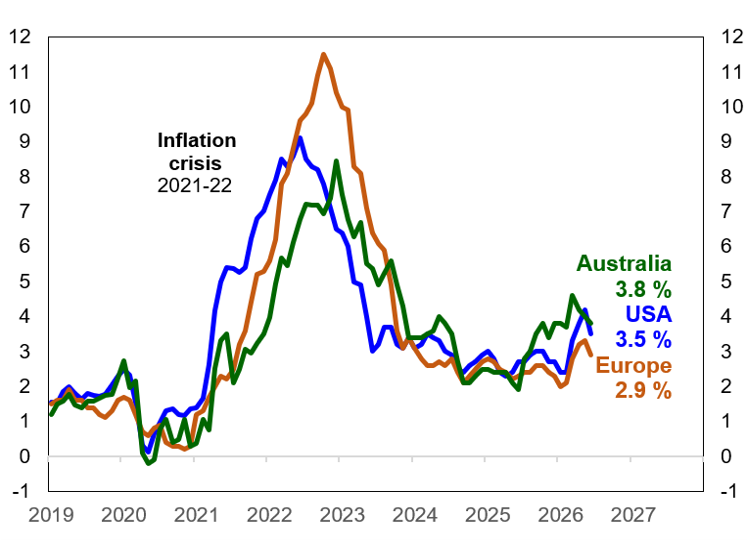
Australian and US headline consumer inflation have registered above the 4% annual rate this year (Chart 1) before moderating to high +3% readings. Europe has seen inflation approach 3%. For central banks who have inflation targets closer to 2% to 2.5%, these inflation results are alarming. For consumers who have to pay higher prices at the service station and supermarket, this high inflation is very troubling.

Chart 1: Global consumer inflation

Sources: Australian Bureau of Statistics, European Commission and US Bureau of Labor Statistics.


Australia’s inflation is a mix of the “good, bad and ugly”

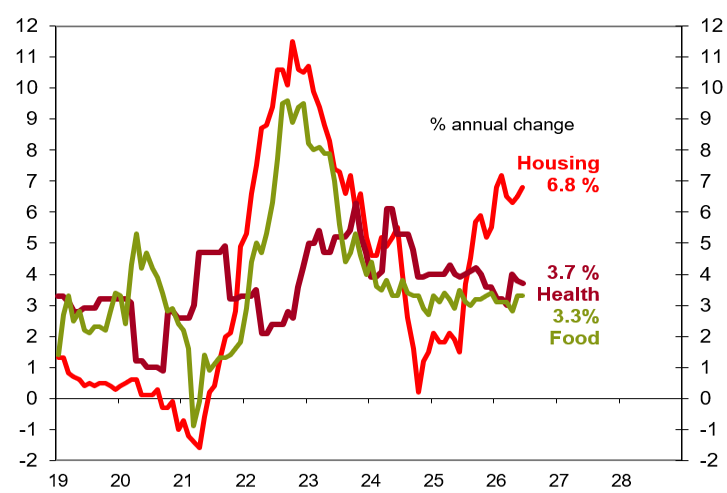
Australian consumers are still being challenged by persistently high inflation. Australia’s 3.8% annual inflation in the year to June 2026 represents a mix of rising goods and services prices. Price pressures in food, health and housing are particularly squeezing consumer budgets (Chart 2).

Food and beverage prices have risen at a 3.3% annual rate to June. There have been some dramatic surges in beef and veal prices (11.9% annual price rises), lamb (14.9%), milk (8.9%) and fruit (6.9%) in the past year.

Health care costs are also rising sharply at a 3.7% annual rate. Medical and hospital costs are up 5% for the past year while dental costs have increased by 3.4%. Effectively very few Australians can afford to get sick.

Notably housing annual inflation at 6.8% in June shows the combined impact of surging electricity prices (+22.4% annual inflation), new dwellings construction costs (+5.8% inflation) and rents (+3.6%).  Electricity price rises are particularly disturbing in how sharply the cost of keeping the lights on have shifted. There were brief “good” times when the Federal and State Governments were providing rebates to lower electricity bills to the current “ugly” times of surging power bills.

Chart 2: Australia’s persistent price pressures

Source: Australian Bureau of Statistics.

Fuel costs are also swinging wildly. The Iran War has been the primary driver of the sharp shifts in petrol and diesel costs this year. While the Australian Bureau of Statistics measure shows that automotive prices have fallen by -7.3% in the past year to June, this “good” result is due to the Federal Government fuel excise tax cut in March this year. Given the full government fuel excise tax of 32 cents per litre is due to be re-instated from August 2026 onwards, the weekly visit to the petrol station will be painful from here on.
 

Can Australia’s inflation rate decline given the current climate?

The RBA is forecasting that headline inflation should gradually fall towards the 2% to 3% target range over the next year.  This forecast is dependent on global oil prices peaking at US$100 per barrel this year and then grinding down to US$75 over next year with the Iran War ending. Given the current global oil prices at circa US$85 with limited prospects for the Iran War ending soon, the RBA’s current forecast seems optimistic.

The RBA is also relying on a slowdown in Australia’s economic activity to moderate price pressures. The RBA Governor noted this when stating that “the growth of demand has to slow in order to bring it (inflation) down”.

Australia’s economy is already in the slow lane. Consumer spending is starting to soften as households struggle with high inflation and three interest rate rises in 2026. The Federal Government’s announcement of major changes to capital gains tax and negative gearing in May has also cast a shadow over prospects for the residential property market. Australian house prices are falling with sharp declines in Sydney and Melbourne.

However, the challenge is whether this current Australian economic slowdown is sufficient to reduce inflation. The RBA seems to be leaning towards raising interest rates again judging by the further comment from the RBA Governor that “if it looks like that inflation is not coming down then I think the (RBA) Board have some difficult decisions to make in terms of raising interest rates.”

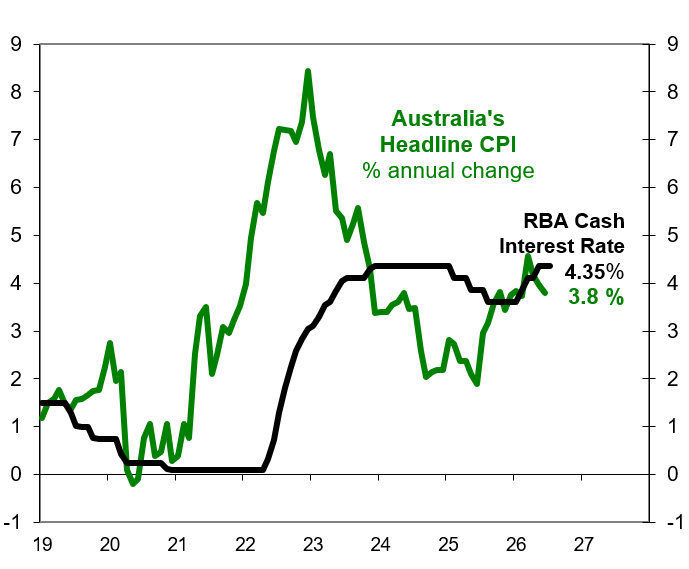
Regrettably the three interest rate rises this year which have pushed Australia’s cash interest rate to 4.35% (Chart 3) may prove insufficient to significantly lower inflation. Accordingly, borrowers and investors need to brace themselves for further potential RBA interest rate rises this year given the troubling path of inflation.

Chart 3: Australia’s inflation versus cash interest rate

Source: Australian Bureau of Statistics.


1 ‘Monetary Policy in an Era of Shocks’ speech, Reserve Bank of Australia Governor Michele Bullock, 28 July, 2026.

You might also be interested in

  • This communication is provided by MLC Investments Limited (ABN 30 002 641 661, AFSL 230705) (MLC), part of the Insignia Financial Group of companies (comprising Insignia Financial Ltd, ABN 49 100 103 722 and its related bodies corporate) (‘Insignia Financial Group’). An investment with MLC does not represent a deposit or liability of, and is not guaranteed by, the Insignia Financial Group.

    This information may constitute general advice. It has been prepared without taking account of an investor's objectives, financial situation or needs and because of that an investor should, before acting on the advice, consider the appropriateness of the advice having regard to their personal objectives, financial situation, and needs.

    Past performance is not a reliable indicator of future performance. Share market returns are all in local currency.

    Any opinions expressed in this communication constitute our judgement at the time of issue and are subject to change. We believe that the information contained in this communication is correct and that any estimates, opinions, conclusions, or recommendations are reasonably held or made as at the time of compilation. However, no warranty is made as to their accuracy or reliability (which may change without notice), or other information contained in this communication.

    This information is directed to and prepared for Australian residents only.

    MLC may use the services of any member of the Insignia Financial Group where it makes good business sense to do so and will benefit customers. Amounts paid for these services are always negotiated on an arm's length basis. MLC relies on third parties to provide certain information and is not responsible for its accuracy, nor is MLC liable for any loss arising from a person relying on information provided by third parties.

    Bloomberg Finance L.P. and its affiliates (collectively, “Bloomberg”) do not approve or endorse any information included in this material and disclaim all liability for any loss or damage of any kind arising out of the use of all or any part of this material.

    The funds referred to herein is not sponsored, endorsed, or promoted by MSCI, and MSCI bears no liability with respect to any such funds.